

The capital stack, explained
Senior debt, mezzanine, preferred equity, common equity — who gets paid first, who takes the risk, and why the order decides everything else.
Miami-Dade · Broward · South Florida
Debt placement, preferred equity, acquisitions, and cash-out recapitalizations from $3MM to $250MM — multifamily, hospitality, and industrial across Miami-Dade and Broward.
How capital sits
Senior debt, mezzanine, preferred equity, and sponsor equity each have a job. Ordeg builds the stack around the business plan — not the other way around. Tap a layer for the plain-English role.
Permanent, bridge, or construction debt that funds the bulk of the project and sets the boundaries for everything above it.
Sits behind senior debt to stretch proceeds when the business plan needs more than first-position leverage alone can deliver.
Gap capital that finishes the stack while day-to-day control stays with the sponsor — priced and timed to the plan.
The sponsor’s own capital at the top of the stack — the layer that aligns incentives and absorbs residual risk and upside.
Descriptive only. Not an offer of securities, a commitment to lend, or a representation of available terms. Financing subject to lender approval and definitive documentation.
Why Ordeg
There is no shortage of people who will forward your deal to a distribution list. What changes the outcome is underwriting it first, matching it deliberately, and staying in the file until it funds.
Our job is the sponsor’s outcome — proceeds, flexibility, and terms you can live with for the whole hold period. We are not placing a product; we are structuring your deal.
Every deal is modeled and stress-tested before it leaves the building. A file that answers the hard questions up front moves faster and retrades less.
Deals go to capital whose appetite genuinely matches the asset, market, and sponsorship. A well-matched conversation beats fifty poorly matched ones.

How it works
Most sponsors arrive with the same four questions. These answer them in a few minutes each — what the capital stack actually is, where preferred equity fits, what a lender reads first, and what happens after a term sheet is signed.

Senior debt, mezzanine, preferred equity, common equity — who gets paid first, who takes the risk, and why the order decides everything else.
Two instruments that fill the same gap and behave very differently. What separates them, and how the choice changes who controls the asset.
The rent roll, the trailing twelve, the sponsor, the exit. What gets read first, what gets verified, and where deals quietly fall apart.
A signed term sheet is the start of the hard part. Appraisal, third-party reports, legal, and the sixty days where a deal is won or lost.
Selected closings
A selection of recent closings. Not a complete record.
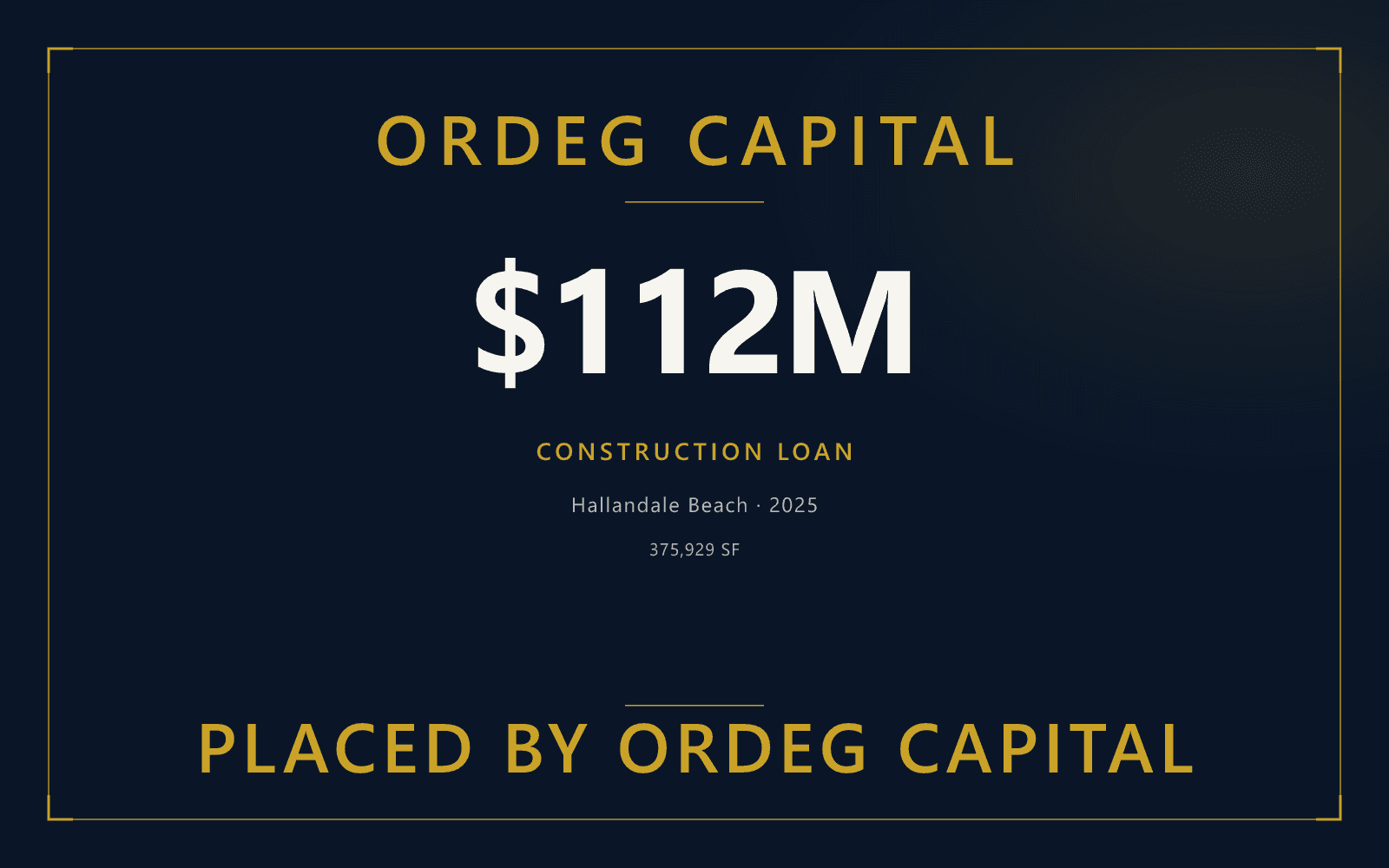
Construction loan · 375,929 SF · 2025
Placed by Ordeg Capital
Jose Degwitz, far right · Source: Traded
Construction loan for a Hallandale Beach condominium, as reported on Traded.
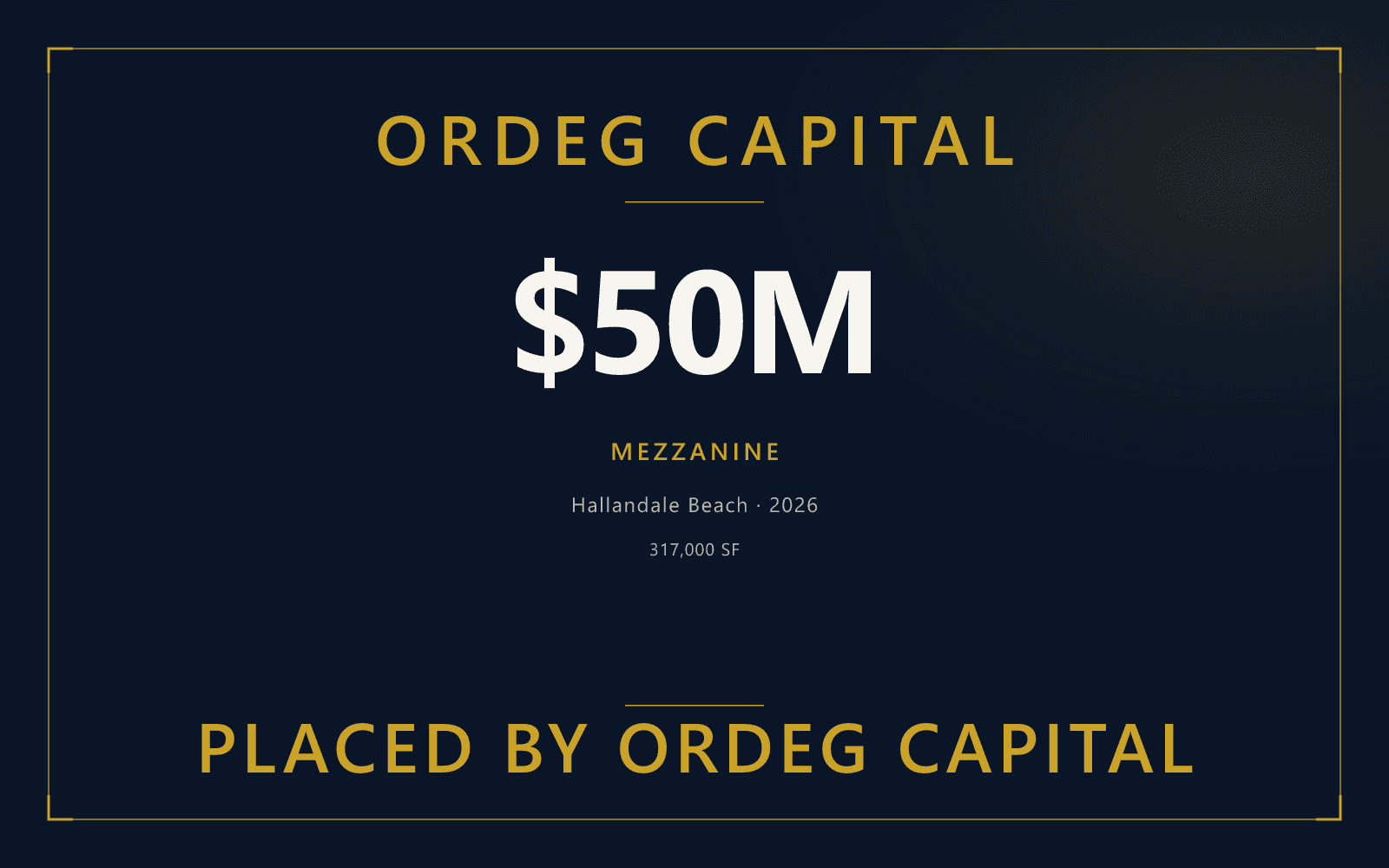
View on TradedMezzanine · 317,000 SF · 2026
Placed by Ordeg Capital
Jose Degwitz, far right · Source: Traded
Mezzanine financing for Oasis Hallandale at 1000 East Hallandale Beach Boulevard, as reported on Traded.
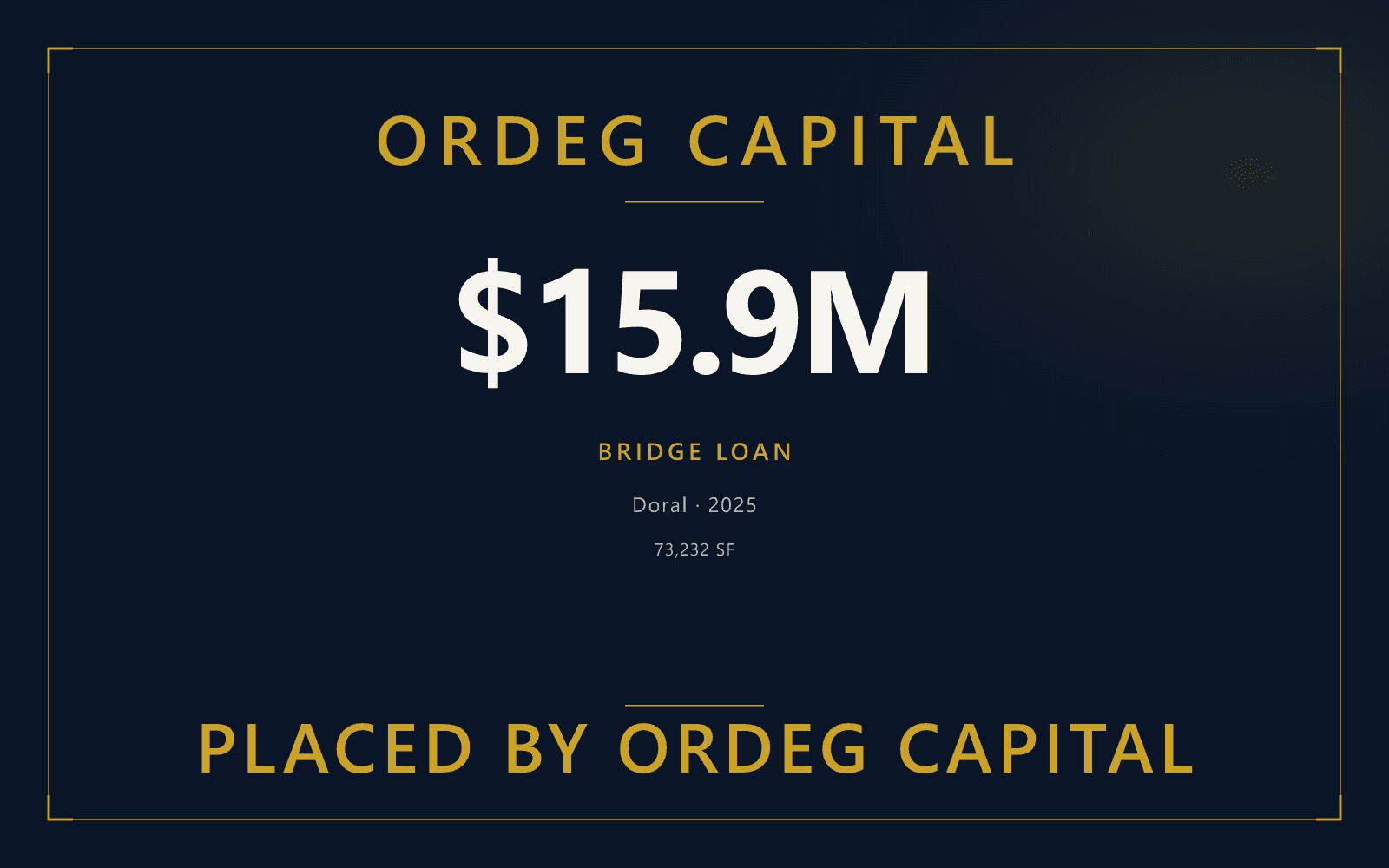
View on TradedBridge loan · 73,232 SF · 2025
Placed by Ordeg Capital
Jose Degwitz, far right · Source: Traded
Bridge loan on a hospitality asset at 1212 Northwest 82nd Avenue in Doral, as reported on Traded.
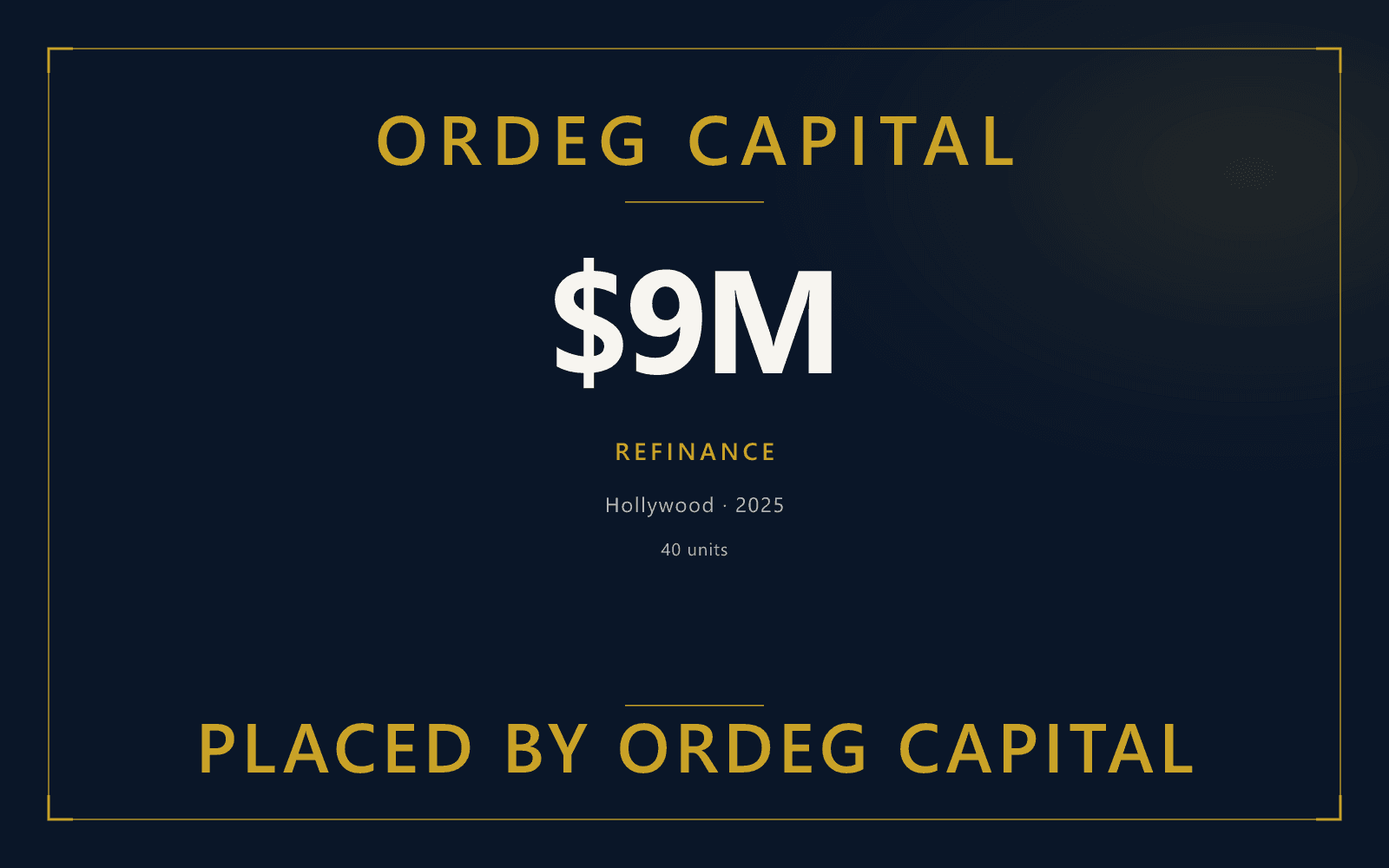
View on TradedRefinance · 40 units · 2025
Placed by Ordeg Capital
Jose Degwitz, far right · Source: Traded
Refinance of a 40-unit multifamily at 1850 Monroe Street in Hollywood, as reported on Traded.
View on TradedSource: Traded. Retrieved 22 August 2026.
These six closings are as published on Traded and on Jose Degwitz’s Traded profile. Jose Degwitz of Ordeg Capital is the person on the far right of each card. Deal graphics are from Traded. Past transactions are not a prediction or guarantee of future results, and nothing here is a representation that similar financing is available. Financing subject to lender approval. Not a commitment to lend.
The process
No black box. Every engagement runs the same way, and at each step you know what we are doing, what we need from you, and what happens next.
Day 1
You send the property, the business plan, and the capital need. We come back with a straight read on how the deal is likely to be received — and what we would change before it goes anywhere.
Days 2–7
We build the model, pressure-test the assumptions against real South Florida comparables, stress the coverage, and find the issues a credit committee will find — while there is still time to answer them.
Week 2
We design the stack the business plan actually needs: the senior layer, the structured layer if there is a gap, and the terms that decide what you can do for the rest of the hold.
Weeks 2–5
A targeted process, not a broadcast — the deal goes to capital whose appetite genuinely matches the asset. We negotiate proceeds, recourse, reserves, prepayment, and draw mechanics on your side of the table.
Through closing
We hold the timeline through appraisal, third-party reports, and legal, surfacing problems while they are still solvable. Deals do not die at term sheet — they die in the sixty days after it.
Timelines are indicative and vary by asset, structure, and diligence. Financing subject to lender approval. Not a commitment to lend.
Quick tool
Enter the property’s net operating income and the debt you are contemplating. The calculator returns the annual debt service and the resulting coverage ratio. It runs entirely in your browser — nothing is sent anywhere, and nothing is stored.
Debt service coverage ratio
1.32x
Lender-ready (>= 1.25x)Net operating income ÷ annual debt service.
As entered, coverage clears the 1.25x lender-ready band used on this page. A given lender may still require more depending on the asset, the structure, and the sponsor.
Illustrative only. This calculator uses the figures you enter and does not reflect any offer, quote, or available terms. It is not a commitment to lend and financing remains subject to lender approval and full underwriting.
Quick tool
Lenders size on the tightest of three tests: DSCR, LTV, and debt yield. Enter the income and the value. The tool runs all three and names the one that governs. It runs in your browser — nothing is sent anywhere, and nothing is stored.
Sized loan
Enter income and value to size the loan.
Two figures are enough to start: annual net operating income and the property value. The result is the smallest of the three lender tests, with the binding one named in plain language — not a single-ratio calculator that hides the constraint that actually caps proceeds.
Illustrative sizing only. Not a quote, not a commitment to lend, and not a representation that these terms are available.
Ordeg Group
Commercial capital is where we start. When a deal needs residential financing, coverage, or the accounting behind it, that work stays inside the group — same standard, same people, no handoff to a stranger.
Residential financing
Residential mortgage financing for South Florida buyers and owners, including foreign nationals and investors buying rental property.
Site coming soonCoverage and risk
Property and liability coverage placed alongside the financing, so the insurance requirement in the loan documents is handled before closing, not after.
Site coming soonAccounting and tax
Bookkeeping, entity accounting, and tax work for real estate owners — including the clean financial statements a lender will ask for.
Site coming soonEach company is engaged separately. Working with one is never a condition of working with another.
Start here
The property, the business plan, and the capital need are enough to start. You will get an honest read on how it is likely to be received — including if the answer is that it is not ready yet.
Cookie notice
Financing subject to lender approval. Not a commitment to lend.